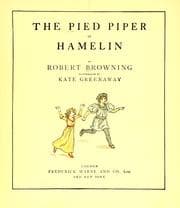
- English
- catalog edition 1888
The pied piper of Hamelin ...
The Pied Piper of Hamelin (German: Rattenf�nger von Hameln, also known as the Pan Piper, the Rat-Catcher of Hamelin) is the title character of a legend from the town of Hamelin (Hameln), Lower Saxony, Germany. The legend dates back to the Middle Ages, the earliest references describing a piper, dressed in multicolored ("pied") clothing, who was a rat-catcher hired by the town to lure rats away with his magic pipe. When the citizens refuse to pay for this service, he retaliates by using his instrument's magical power on their children, leading them away as he had the rats. This version of the story spread as folklore and has appeared in the writings of Johann Wolfgang von Goethe, the Brothers Grimm, and Robert Browning, among others.There are many contradictory theories about the Pied Piper. Some have been proposed suggesting he was a symbol of hope to the people of Hamelin, which had been attacked by plague; he moved all the rats out from the town of Hamelin, thus saving the people from the epidemic disease.1592 painting of Pied Piper copied from the glass window of Marktkirche in HamelnThe earliest known record of this story is from the town of Hamelin itself, depicted in a stained glass window created for the church of Hamelin, which dates to around 1300. Although it was destroyed in 1660, several written accounts have survived.
34
pages
~1h
estimated · 30 pages/hour
the reading room
Keep the thread going.
One quiet exit, after the marks that matter.